











Welcome to this month’s ASO Monthly – your go-to update on the most impactful developments in App Store Optimization.
Each month we cover algorithm changes, emerging trends, CRO insights, tool updates, and everything else that matters across the major app stores.
📬 Sign up for our newsletter to stay in the loop with every drop.
Subscribe to the ASO Monthly Newsletter
Get the latest ASO updates straight to your inbox, once a month.
Apple Publishes 2025 App Store Fraud Report
What happened: Apple published its annual App Store fraud and trust report for 2025, saying it prevented more than $2.2 billion in fraudulent transactions, rejected more than 2 million app submissions, blocked 1.1 billion fraudulent account creations, deactivated 40.4 million customer accounts, terminated 193,000 developer accounts, and blocked close to 195 million fraudulent ratings and reviews.
The most important ASO signal is review integrity. Of the 1.3 billion ratings and reviews submitted in 2025, nearly 195 million were identified and blocked as fraudulent. Apple also blocked close to 28,000 illegitimate apps on pirate storefronts.
| Metric | 2025 figure |
| Fraudulent transactions prevented | $2.2 billion+ |
| App submissions rejected | 2 million+ |
| Fraudulent customer account creations blocked | 1.1 billion |
| Customer accounts deactivated for fraud | 40.4 million |
| Developer accounts terminated for fraud | 193,000 |
| Fraudulent ratings and reviews blocked | ~195 million |
| App Review submissions evaluated | 9.1 million+ |
| New developers welcomed | 306,000+ |
Source: Apple Newsroom / SecurityWeek
Apple Announces WWDC26 Dates and 2026 Apple Design Award Finalists
What happened: Apple confirmed that WWDC26 will take place from June 8 to June 12, 2026. For ASO teams, WWDC is one of the most important annual checkpoints because Apple often uses the event to announce iOS changes, App Store tools, App Store Connect updates, featuring changes, and subscription improvements.
Apple also published the finalists for the 2026 Apple Design Awards across Innovation, Interaction, Inclusivity, Social Impact, Visuals and Graphics, and Delight and Fun.
ASO impact: WWDC26 should be on every ASO team’s roadmap. Announcements can affect keyword indexing, metadata fields, Custom Product Page strategy, in-app event surfaces, and subscription APIs. Audit your current setup before the event so you can move quickly if Apple opens new levers. Separately, the Design Award finalists are a useful signal of the product quality, creative execution, and UX patterns Apple’s editorial team is rewarding.
Source: Apple News
App Store Age Rating Updates for Australia and Vietnam
What happened: Starting June 18, 2026, Apple will update the App Store age rating system for Australia and Vietnam. In Australia, the 15+ tier will be removed and affected apps will be reclassified as 16+ depending on their App Store Connect content settings. In Vietnam, Apple is introducing a localized age rating system with 0+, 12+, 16+, and 18+ tiers.
ASO impact: Developers with apps in Australia or Vietnam should review age rating configurations before June 18. Incorrect classifications can affect discoverability through age-gated search results, conversion through visible rating badges, and compliance. Given Apple’s recent enforcement around 18+ apps in Australia, Brazil, and Singapore, this should be treated as an APAC listing audit checkpoint rather than a passive admin update.
Source: Apple News
Ask Play: Google’s AI-Powered Conversational Search Goes Live
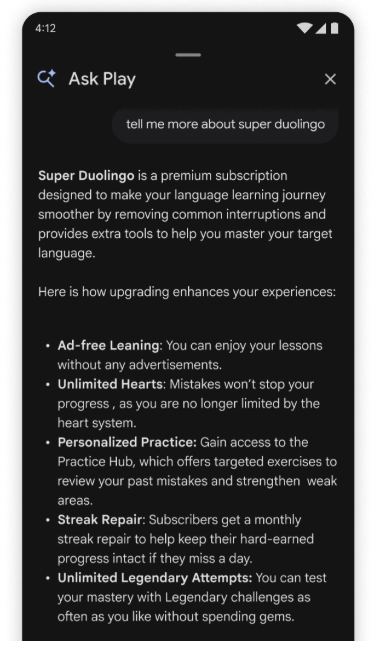
What happened: At Google I/O 2026, Google announced Ask Play, an AI-powered conversational search interface embedded within Google Play. Powered by Gemini models, Ask Play lets users search for apps and games using natural-language queries and receive contextual recommendations through a conversational interface.
Google is also testing Ask Play Highlights: AI-generated summaries that appear directly on search results pages. AppTweak’s testing found that Ask Play can draw information from both a Play Store listing and the app’s website, which means store descriptions and websites now need to tell the same story.
AI-generated discovery can also push traditional organic results much lower. For conversational queries, users may see paid ads, Gemini-generated app lists, Ask Play recommendations, and follow-up prompts before reaching classic organic results.
ASO impact: The immediate priority is not only keyword stuffing, but AI-readability. Front-load what the app does, who it is for, and the specific problems it solves. Remove vague phrases that do not help a language model understand relevance. Just as important, audit your website for consistency with your Play Store copy. Contradictory owned-surface signals can produce weak or incoherent AI recommendations.
 Source: Android Developers Blog
Play Shorts: Short-Form Video Discovery Now Rolling Out
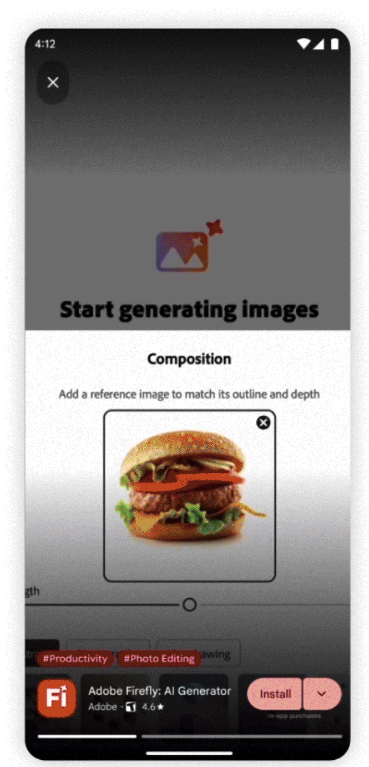
What happened: Google confirmed that Play Shorts is rolling out to US users and select developers, with expansion planned for more markets and developers. Play Shorts is a full-screen, portrait-oriented short-form video feed inside the Google Play Apps tab, allowing users to preview apps in action before downloading. It includes one-tap install actions directly from the feed.
The format also supports drama shorts, webtoon previews, and audio, manga, and comics samples, making it a broader content discovery surface rather than only an app-preview format.
ASO impact: Play Shorts creates a new organic discovery surface outside keyword search, chart ranking, and listing-page conversion. It favors dynamic visual storytelling over static screenshots. Teams with strong short-form video learnings from paid UA now have a direct organic use case for that creative work. Early participation, while rollout is still limited, can create a first-mover advantage before the format becomes crowded.
Source: Google Play Help / Android Developers Blog
Google Play Integrates App Discovery into Gemini App
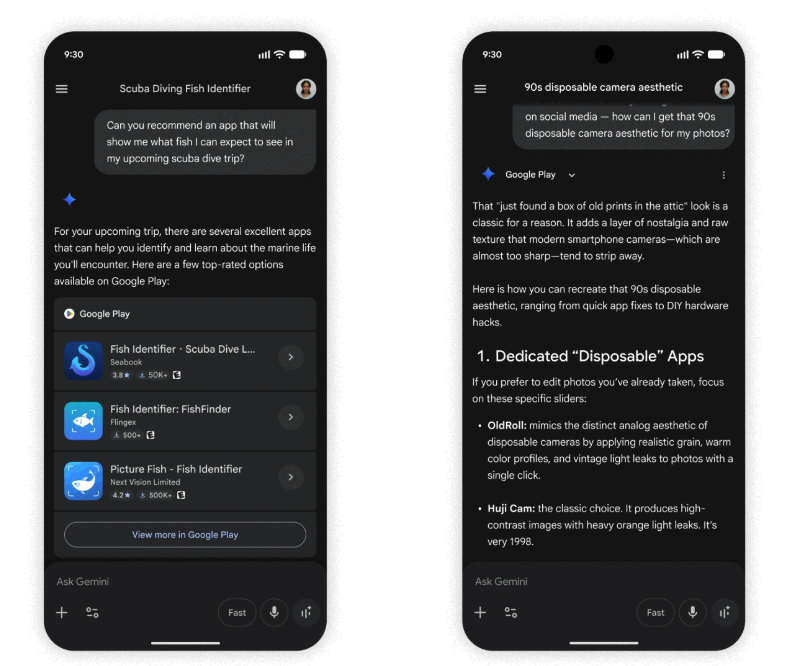
What happened: Google announced that users of the Android and web versions of Gemini will begin receiving app and game recommendations directly inside the assistant, without needing to open Google Play. Google also confirmed plans for deep linking, allowing users to move from a Gemini recommendation directly into specific app content.
ASO impact: App discovery is moving beyond the store surface. A user searching for a productivity or entertainment recommendation in Gemini could discover and install an app without first visiting the Play Store listing. That means the classic funnel of impressions, listing visits, and installs may be bypassed for some traffic. Publishers that adopt AppFunctions and ContextSDK early are most likely to benefit, because these integrations help Google’s AI understand which apps can usefully surface in conversational contexts.
Source: Android Developers Blog / AppTweak
Google Play Console Adds AI Localization and New Reach Metrics
What happened: Google announced two Play Console improvements at I/O 2026. First, developers can upload a structured CSV or Google Sheet with listing copy, and Gemini can pre-populate multilingual store listings for review. AI-translated subscription benefit text is also available.
Second, Google is introducing a new reach metric to help developers understand visibility across the Play Store beyond listing-page views. New traffic-source breakdowns will connect performance with engagement, retention, and monetization, while cart conversion rates are being added to core metrics.
ASO impact: AI localization lowers the effort required to keep listings current across many markets, especially in LATAM, APAC, and MENA. It should be treated as a starting point, not a final publishing step: native review is still essential for cultural nuance and conversion quality. The new reach and traffic metrics should also help ASO teams understand whether discovery is happening through classic listings, content surfaces, AI-led entry points, or other Play Store placements.
Source: Android Developers Blog
Interesting Reads/Listens/Watches
Google I/O 2026: What Mobile Growth Teams Need to Know | Phiture
App Store Optimization Title: The 2026 Playbook for iOS & Google Play | Android Developers Blog
ASO with Experts:
Google I/O 2026 confirmed what many ASO teams already suspected: AI is no longer a future consideration for app discovery. Ask Play is live, it is reading Play Store listings, it is pulling from app websites, and for a growing set of conversational searches, it appears above traditional organic rankings.
The temptation is to treat this as a purely technical problem: optimize for the AI, change the metadata structure, add the right keywords. But the stronger frame needs to be clarity. Gemini and other language models work best with descriptions that are specific, structured, and unambiguous. Apps that clearly explain what they do, who they serve, and what problem they solve will be easier for AI systems to recommend. Start by auditing the long description. If a phrase sounds vague in a real conversation, it is probably vague for AI discovery too. Then check the website. If the top feature is described differently there than it is in the store listing, the app is sending contradictory signals. Consistency between owned surfaces is quietly becoming one of the highest-leverage, lowest-cost ASO improvements available right now.
Talha Mumtaz
Senior Growth Manager
Table of Contents