











Welcome to this month’s edition of ASO Monthly — your go-to update on what’s moving the needle in App Store Optimization.
We break down the latest algorithm changes, trends, and experiments across app stores, alongside CRO insights, tool updates, and developer platform news.
📬 Subscribe to our newsletter to get ASO Monthly in your inbox every month:
Subscribe to the ASO Monthly Newsletter
Get the latest ASO updates straight to your inbox, once a month.
One of the most significant algorithm changes by Apple was reported in July
What happened: Between July 27 and 28, the App Store experienced significant algorithm changes across several markets, including the US, Canada, Brazil, China, and India. The change was particularly prominent in India, where the anomaly score reached 22.8, compared with a typical score of below 2.
While the exact nature of the update remains unclear, it has caused substantial fluctuations in keyword rankings across many apps. Some apps stopped ranking for generic keywords, while others saw improvements. One possible observation is that the algorithm is placing greater emphasis on semantic relevance, although this has not yet been confirmed or validated at scale.
We do not recommend releasing new metadata updates immediately, as this could create further volatility or negatively affect performance. Instead, first assess the impact by identifying which keywords experienced the largest declines and whether they can be supported through conversion-rate optimization or paid acquisition activities.
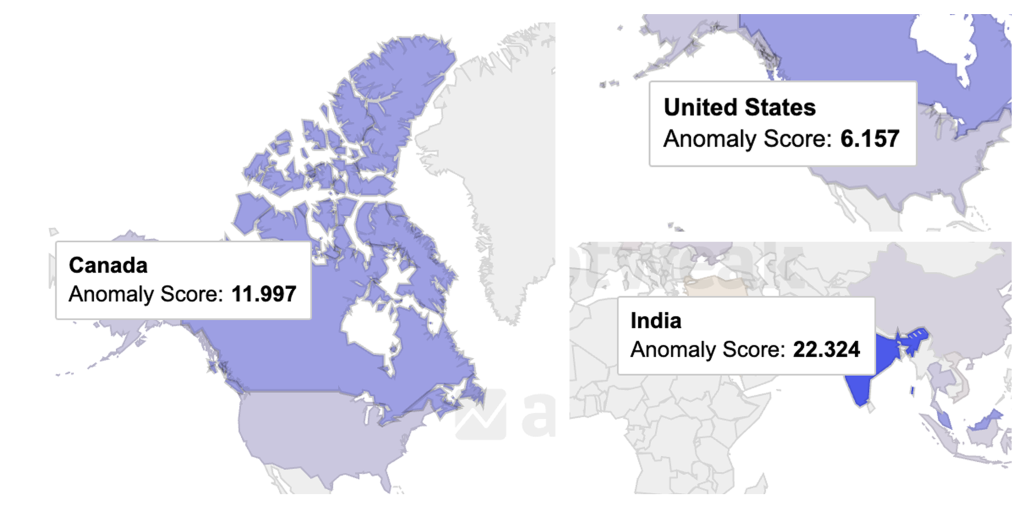
Source: AppTweak Algorithm Monitoring Tool
Google Play will syndicate US app listings to third-party US Android app stores
What happened: Google announced that starting July 22, 2026, US app and game listings (including app names, icons, descriptions, screenshots, and videos) can be made available to third-party US Android app stores through the Play Catalog Access program unless developers opt out or manage preferences in Play Console under Catalog Settings.
Source: Here
New impression metrics added to Play Console’s Reach section
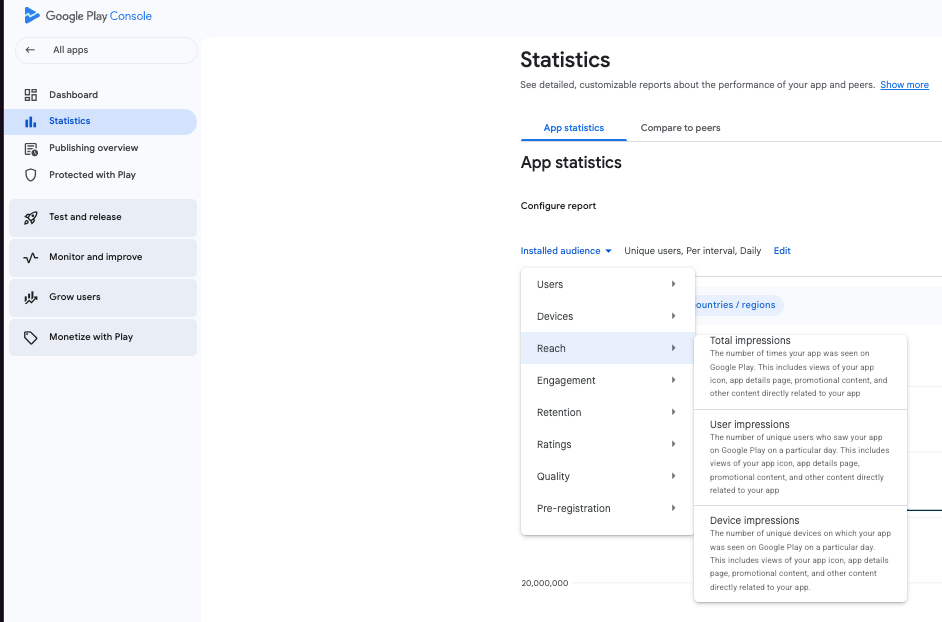
What happened: Google Play Console added three new impression metrics under the Reach section: Total impressions, User impressions, and Device impressions. These track how many times an app was shown across the app icon, app details page, and promotional content placements, along with how many unique users and unique devices saw it; segmentation by traffic source is not yet supported.
ASO Impact: This closes a long-standing visibility gap for Android teams that previously had to infer top-of-funnel reach indirectly. Practitioners should immediately start building impression-to-click and click-to-install funnels using these new metrics to isolate whether underperformance stems from a discoverability problem (low impressions) or a conversion problem (low click-through or install rate from adequate impressions).
Store Listing Experiments overhauled with Variant cap reduced & new metrics
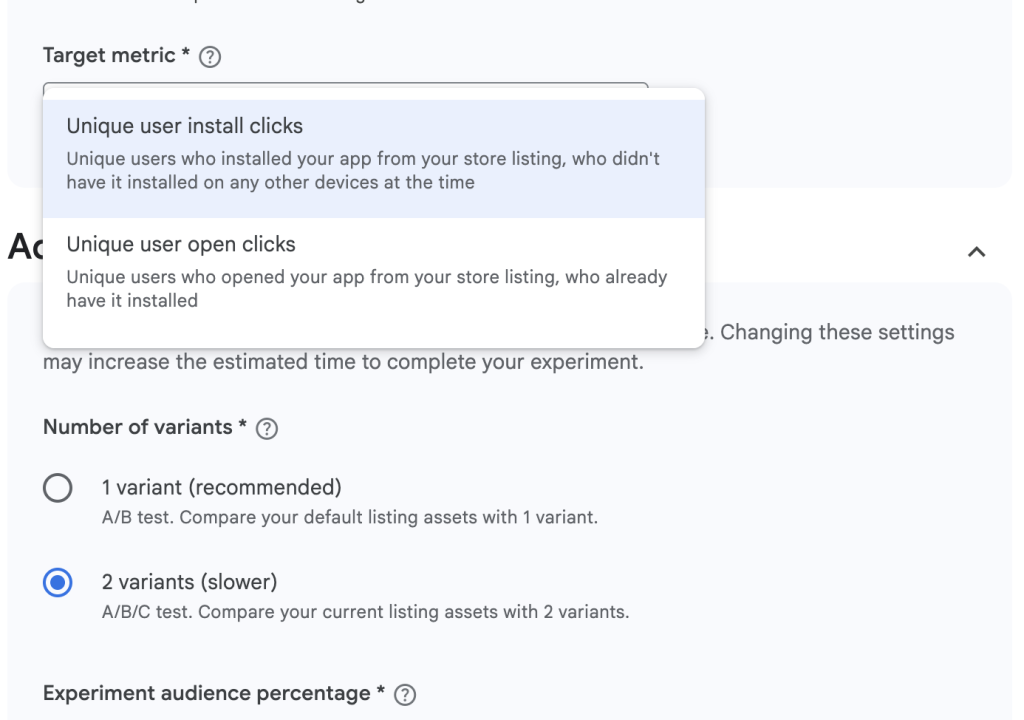
In late July, Google quietly overhauled Store Listing Experiments inside Play Console. Multi-variant (A/B/C) testing (previously allowing up to three variants against a control) appears to have been removed, with developers now limited to standard two-way (A/B) testing. Please note that the regular First-time Installers & Retained First-time Installers metrics have been replaced with User clicks and User opens.
ASO Impact: This is a meaningful workflow change for any team running multi-variant creative tests. With three-variant tests apparently gone, teams that previously ran icon A/B/C tests or three-way screenshot comparisons need to redesign testing roadmaps around sequential two-way tests, which will take longer to cover the same number of creative hypotheses but should produce cleaner, faster-converging results per test given more traffic per variant.
Google Play shifts install reporting to unique clicks on Install/Open/Pre-register buttons
What happened: As of July 2026, Google Play’s store listing performance reports now center on user intent signals (unique clicks on the “Install,” “Open,” and “Pre-register” buttons) rather than only reporting completed install outcomes.
ASO Impact: This is an important CRO shift. Teams should now be able to separate “did the listing convince someone to tap Install” from “did the install actually complete,” thereby isolating listing-page persuasiveness from downstream technical or device-compatibility friction.
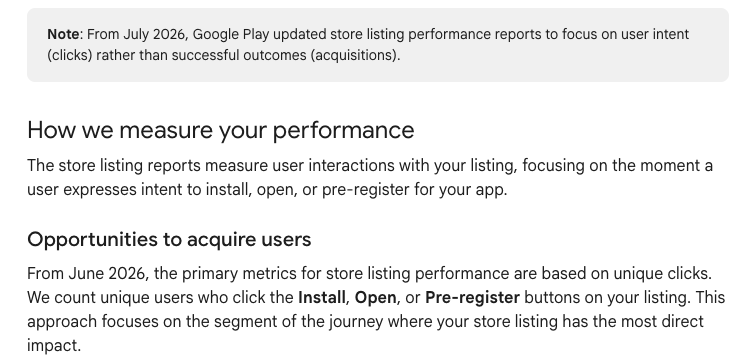 Source: Google Help Center
App Store age rating questionnaire now asks about social media functionality
What happened: Apple updated the App Store Connect age rating questionnaire to include questions about whether an app has social media functionality —> defined as the ability to distribute, promote, or interact with user-generated content through a feed. Apps with this functionality will receive a new Social Media content descriptor on their App Store product page; developers can answer the new questions now, and answering becomes mandatory for new app and update submissions starting September 2026.
Interesting Reads/Listens/Watches
The ASO & Apple Ads trends and benchmarks report 2026 | AppTweak
Review bombing in mobile games: App Store and Google Play recovery guide | AppFollow
The Signal Economy Goes Live: Takeaways from MAU Vegas 2026 | AppsFlyer
ASO with Experts:
If the emerging hypotheses and observed patterns about Apple’s July algorithm update hold (greater weight on semantic relevance, freshness, and engagement quality) then the long-standing ASO strategy of maximizing keyword coverage across title, subtitle, and keyword field needs to evolve toward owning fewer, higher-intent terms backed by strong conversion and retention performance.
Talha Mumtaz
Senior Growth Manager