











Welcome to this month’s edition of ASO Monthly — your go-to update on what’s moving the needle in App Store Optimization.
We break down the latest algorithm changes, trends, and experiments across app stores, alongside CRO insights, tool updates, and developer platform news.
📬 Subscribe to our newsletter to get ASO Monthly in your inbox every month:
Subscribe to the ASO Monthly Newsletter
Get the latest ASO updates straight to your inbox, once a month.
Apple’s Siri AI push could accelerate app discoverability through LLMs
What happened: At Apple’s September 9 event, Apple continued to position Siri and AI as a more central layer across the iOS ecosystem. As AEO gains momentum, Apple’s AI push could make app discovery less dependent on traditional store browsing alone and more influenced by assistant-led recommendations, contextual search, and LLM-driven discovery moments.
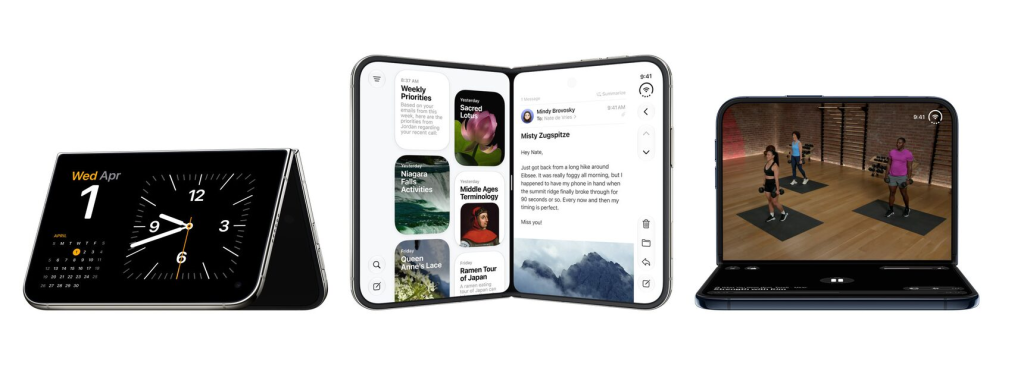
Apple’s iPhone Duo creates a larger canvas for App Store visuals
What happened: Apple introduced the iPhone Duo folding phone, bringing a larger display format into the iPhone ecosystem. The expanded screen real estate could create new opportunities for App Store product pages to tell richer stories through screenshots, videos, and landing page-style creative treatments.
ASO Impact: As adoption grows, ASO teams can test new creative approaches designed for larger displays, especially around screenshot sequencing, product education, and more immersive visual storytelling. Google Play already offers useful reference points through foldable-focused store experiences, such as the MSL/LD treatment for Scan on Samsung Ultra Fold, where the larger display supports a more compelling product story.
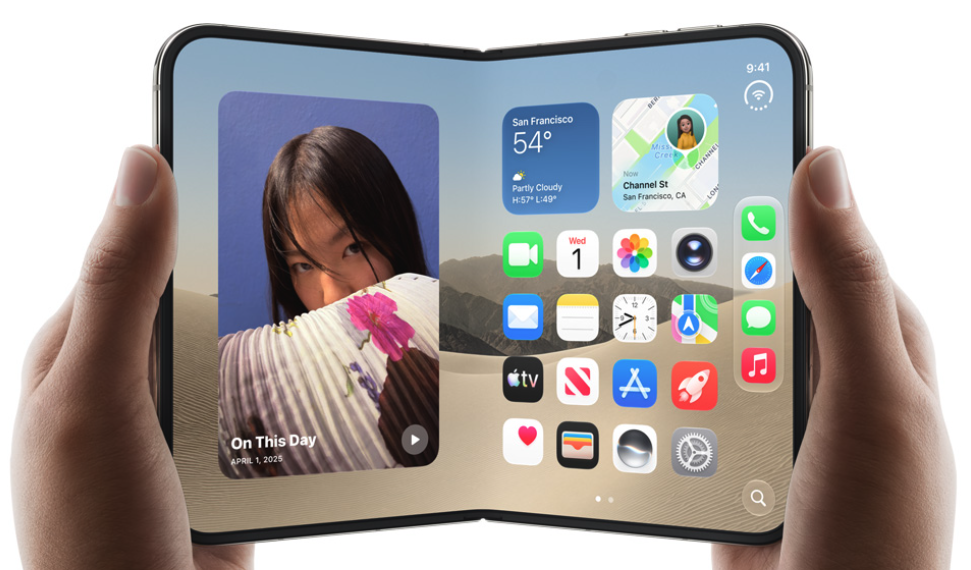 Image Source: Here
iPhone Duo opens new feature-led storytelling and featuring opportunities
What happened: Apple’s iPhone Duo could create new product experiences for apps, especially through a larger foldable display and features like Apple Pencil support. This is particularly relevant for apps where the user journey changes by context, such as reading, annotating, editing, creating, reviewing, or multitasking. Apps will also likely need new Duo-specific App Store screenshots to properly showcase the experience on the larger format. Those that optimize early and submit a timely App Store featuring nomination may have a stronger chance of being considered while Apple is looking for strong examples built for the new device format.
ASO Impact: The opportunity is both creative and visibility-led. Duo-specific screenshots can help apps tell clearer feature-led stories for specific jobs-to-be-done, while the device launch itself creates a fresh reason to pitch the app for App Store featuring. The sooner teams adapt their product experience, update their App Store assets, and submit relevant featuring nominations, the better their chances of benefiting from early editorial visibility around the new device launch.
 Source: Here
Google Play adds broader targeting capabilities for Custom Store Listings
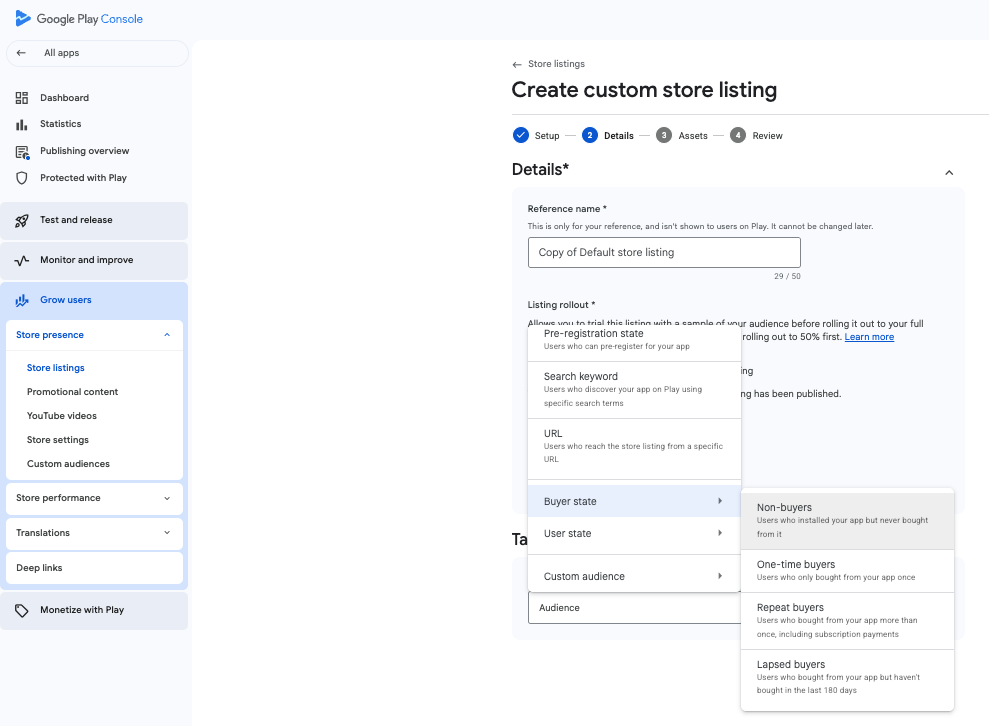
What happened: In August, Google expanded Custom Store Listing (CSL) targeting with new audience segmentation capabilities. Publishers and ASO teams can now target churned and inactive users, either separately or together, as well as audiences based on purchase behavior, including lapsed buyers, repeat buyers, one-time buyers, and non-buyers. Google also introduced custom audience targeting, allowing teams to define specific user groups manually via CSV upload or programmatically through Google’s grouping API.
ASO Impact: CSLs are becoming a more powerful integrated growth tool, moving beyond acquisition-focused targeting. ASO teams can now tailor store messaging and creatives based on a user’s relationship with the app, for example, highlighting new content to churned users, stronger value propositions to non-buyers, or exclusive benefits to previous purchasers. This creates opportunities to test audience-specific creative strategies across acquisition, retention, reactivation, and monetization, rather than relying on a single store experience for all returning users.
Android showed a high anomaly score across key markets
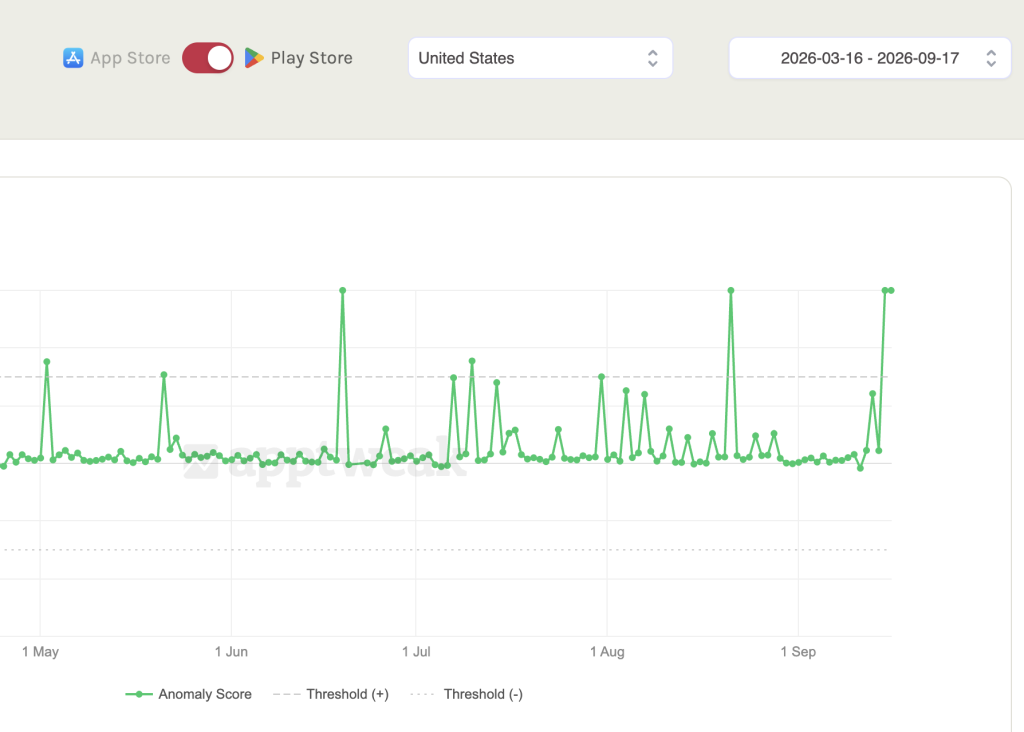
What happened: Around September 15/16, Android showed a high anomaly score worldwide, with the United States also showing a clear spike above the normal anomaly threshold. This suggests a broader Play Store movement rather than a single-app or single-market fluctuation.
ASO Impact: A high anomaly score usually means app visibility, rankings, or traffic patterns may have shifted unusually compared to the baseline. ASO teams should review Android performance around September 15/16 across Search, Explore, keyword rankings, store listing visitors, and conversion rate to understand whether the spike created visibility gains, traffic quality changes, or unexpected CVR softness. This should be treated as a monitoring signal first, then validated against app-level and market-level data before concluding.
Google Play now supports A/B testing for lapsed and churned user CSLs
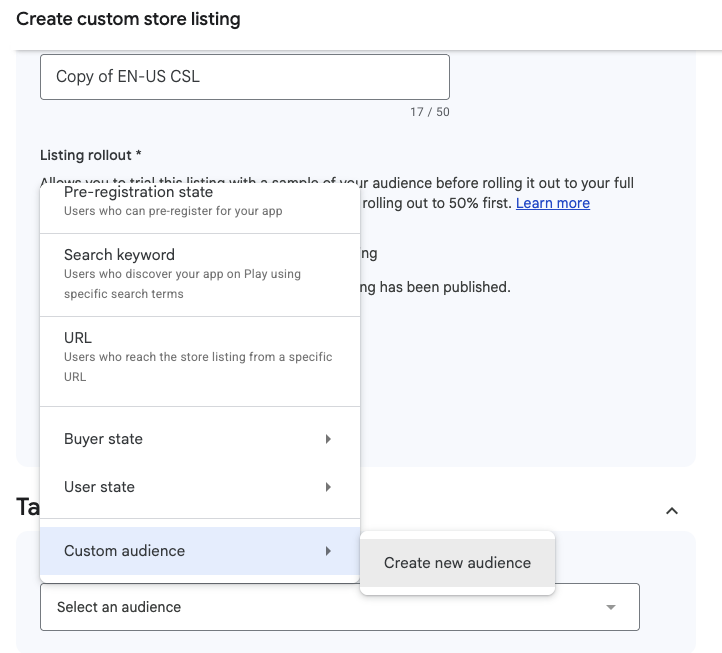
What happened: Google Play now allows developers to run A/B tests on Custom Store Listings that target lapsed and churned users. This means teams can test different creatives, messaging, screenshots, icons, and descriptions specifically for users who have uninstalled the app or have not opened it recently.
ASO Impact: This is an important step for lifecycle-focused ASO because teams can now validate what actually works for reactivation audiences instead of relying on one generic comeback message. Apps can test whether new features, fresh content, offers, social proof, or stronger value propositions are more effective at bringing users back. This makes CSL testing more useful for retention and re-engagement, not just new-user acquisition.
Google Play adds broader audience targeting for Custom Store Listings
What happened: Google Play has expanded Custom Store Listing targeting with more audience-based options. Developers can now target lapsed users, churned users, or both separately, and can also target purchase-based segments including non-buyers, one-time buyers, repeat buyers, and lapsed buyers. Google also now supports custom audiences for Play Store content, created either through the Play Grouping API or CSV email lists, similar to custom audience targeting for Promotional Content events.
ASO Impact: This makes CSLs a much stronger lifecycle and monetization tool, not just an acquisition tool. ASO teams can now tailor store messaging based on where the user is in the journey, for example showing new features to churned users, comeback messaging to lapsed users, premium value propositions to non-buyers, or loyalty-led messaging to repeat buyers. This opens up stronger collaboration between ASO, CRM, Paid UA, and monetization teams, helping create store experiences that support acquisition, reactivation, retention, and purchase conversion.
Interesting Reads/Listens/Watches
How reviews impact ASO: The real mechanism | AppFollow
4 experiments to improve your app’s AI visibility | AppTweak
EU Digital Services Act: ChatGPT, Reddit and Roblox Face Strict New Rules | Phiture
ASO with Experts:
As LLMs become a more important layer of app discovery, brands need to think beyond app store metadata and make sure their wider web presence is clear, consistent, and easy for AI systems to understand. Wikipedia, official websites, social media profiles, press pages, and other authoritative sources all help LLMs build an understanding of what your app does, who it is for, and why it matters. The goal should be to keep this information objective, factual, aligned, fresh, and structured around the brand’s identity. This will make AEO a more connected part of ASO, helping brands improve how they are understood, surfaced, and recommended across AI-led discovery journeys.
Talha Mumtaz
Senior Growth Manager
Table of Contents