











The EU AI Act regulates and assesses the risk of what AI creates and to what extent it interferes with our day-to-day life.
In this case, to ensure users are aware if an ad or the store listing content they are seeing for an app or game has been generated with AI, marketers, developers, advertisers, and publishers need to declare whether their content has been AI-generated.
Though this is an EU regulation, it affects everyone, as assets can be viewed and accessed from any side of the world.
How is the EU AI Act affecting your App Store Optimization (ASO) Strategy?
Since 2nd August 2026, the Google Play Console makes it mandatory to declare whether your store listing assets (such as text, images, or video) have been AI-generated.
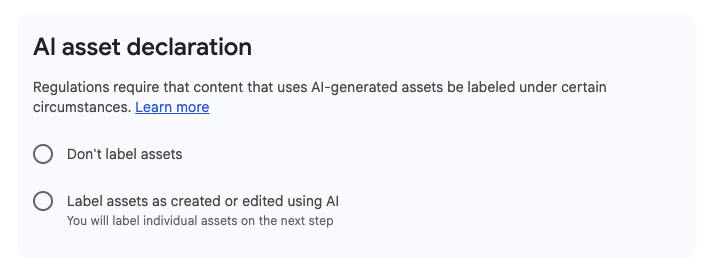 This means that you need to declare:
- Visual Assets: For icons, screenshots, videos, and feature graphics, you need to declare if AI was involved in fine-tuning or creating the visual asset the user is seeing on the store. Once you submit the declaration, Google Play will include a public label.
- Written Assets: When your texts (title, short and long descriptions) are generated by AI, you should declare it. It is always recommended that at the final stage – before pushing the content live- a human runs a final review of the text, ensuring everything is properly adapted to the language of the store and accurately reflects the app/game features.
As part of the EU AI Act, and together with the Digital Services Act (DSA), these Very Large Online Platforms (VLOPs) – like the Google Play Store and the iOS App Store – integrate automated detection tools to penalize store listings that fail to disclose synthetic texts and visuals, in direct violation of the EU transparency guidelines.
This is part of a broader shift: see how the DSA and DMA are also reshaping ASO and UA strategy more generally.
What is the EU AI Act?
The EU AI Act is a regulation put in place by the European Union that classifies AI into four risk levels, depending on its impact on human rights and freedom, with tailored rules for each.
It entered into force on 1st August 2024. From that moment, EU countries had 1 year (until 2nd August 2025) to appoint national authorities to ensure the application of the rules enforcing AI regulations and overseeing market surveillance, with the deadline of 2nd August 2026 when the EU AI Act officially kicks in, rolling out the implementation and imposing measures under the regulation.
| Definition | Examples | |
| Level 1 | This is the minimal risk category and requires no regulation. | This includes the majority of AI programs, like, for example, the spam filter of your email account or AI-enabled video games. |
| Level 2 | This one covers limited-risk things. The AI systems in this category include deepfakes, chatbots, among a few other entities. | This is where we will classify ChatGPT, Gemini, Claude, and Perplexity.
The rules declare that you need to be truly transparent with users and always communicate that they are chatting with a bot. |
| Level 3 | The level of risk here assesses AI in critical areas where decisions and actions can have a profound impact and/or put into direct danger the integrity of humans, animals, and the environment.
In all of these systems, there needs to be a detailed log, and humans must be an element of the loop of creation, addressing, and assessing, overseeing the AI and ensuring the outcome respects safety measures. |
This includes elements such as where AI powers self-driving cars, where AI makes decisions that can keep you safe on the road.
Health-care devices and environments, where AI mistakes and precision while assisting during surgeries or diagnosis could have major consequences. The inclusion of AI in education to grade exams and assess student performance, where fairness is crucial, and the system should avoid bias. The inclusion of AI on |
| Level 4 | This higher risk is for unacceptable and completely banned systems in the EU. These are a no-go zone where AI is the judge and jury of your life. |
Examples of this are China’s social credit system, where people’s behavior can make you earn or lose points, impacting travel opportunities or even the kids’ school options. |
Who is responsible for ensuring the application of the EU AI Act?
From 2nd August 2026, supporting the national authorities that each country has defined, the European Artificial Intelligence Board (or AI Board) plays a crucial role in ensuring that the EU AI Act is applied consistently across all member states.
Alongside this, a panel of experts also provides technical advice and issues alerts about potential risks to companies that are not playing by the rules.
In this case, for the bigger rule-breakers, the Act defines penalties that can be up to 7% of the company’s global annual turnover.
FAQ
What is the EU AI Act?
It’s an EU regulation that classifies AI systems into four risk levels based on their impact on human rights and safety, with different rules for each level. It entered into force on August 1, 2024, and fully kicked in on August 2, 2026.
How does the EU AI Act affect ASO?
Since August 2, 2026, Google Play Console requires developers to declare whether their store listing assets, including text, images, and video, were generated using AI. The App Store is expected to follow similar transparency requirements.
What counts as an AI-generated visual asset?
Icons, screenshots, videos, and feature graphics all need a declaration if AI was involved in creating or fine-tuning them. Once declared, Google Play adds a public label to the listing.
Do I need to declare AI-generated text too?
Yes. If your app title, short description, or long description was generated with AI, it needs to be declared. It’s always worth having a human review the final copy before it goes live, to make sure it’s properly localized and accurately reflects what the app actually does.
What happens if I don’t disclose AI-generated content?
Google Play and the App Store, as Very Large Online Platforms under the Digital Services Act, use automated detection tools to flag undisclosed synthetic content. Non-compliance can trigger penalties tied to EU transparency guidelines.
What risk level do tools like ChatGPT or Claude fall under?
They’re classified as limited risk (Level 2), alongside chatbots and deepfakes. The requirement here is transparency: users need to know they’re interacting with AI.
Who enforces the EU AI Act?
The European Artificial Intelligence Board (AI Board) oversees consistent application across member states, supported by national authorities in each country and a panel of technical experts.
What are the penalties for non-compliance?
For serious violations, the Act allows for fines of up to 7% of a company’s global annual turnover.
Does this apply outside the EU?
Yes, in practice. Since app store listings are visible globally, any developer whose content can be seen by EU users needs to comply, regardless of where the company is based.
Table of Contents