











Welcome to this month’s edition of ASO Monthly — your go-to update on what’s moving the needle in App Store Optimization.
We break down the latest algorithm changes, trends, and experiments across app stores, alongside CRO insights, tool updates, and developer platform news.
📬 Subscribe to our newsletter to get ASO Monthly in your inbox every month:
Subscribe to the ASO Monthly Newsletter
Get the latest ASO updates straight to your inbox, once a month.
WWDC26: Product Page Header — A Brand New First Impression
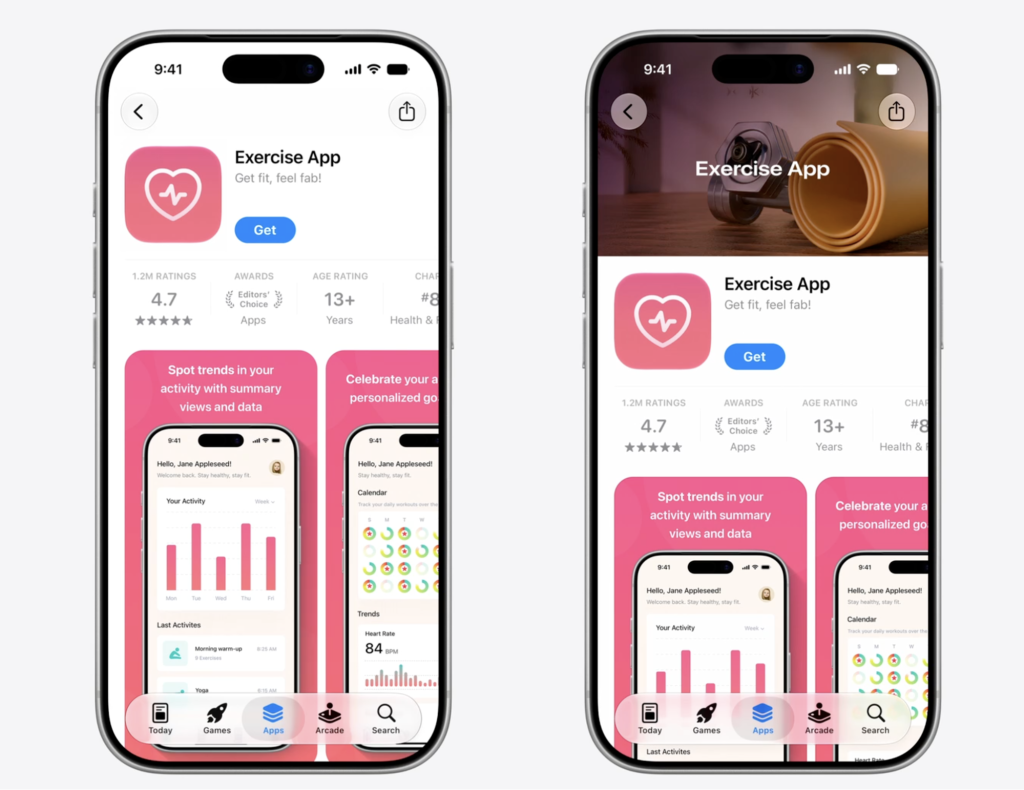
What happened: Apple is introducing a dedicated Product Page Header, a brand-new visual slot that sits at the very top of an app’s product page, above the existing screenshots and app previews. This is the first element users see when they land on an app listing.
The Product Page Header is available for both iOS and iPadOS apps and is managed through the Asset Library in App Store Connect. Apple specifically recommends that the header, app icon, and screenshots work together as a cohesive unit to explain the app experience rather than being designed in isolation. Product Page Optimization (A/B testing) is also supported for the header, allowing teams to test whether users respond better to a brand logo, a core value proposition image, a seasonal campaign visual, or a new feature highlight.
 Source: Apple
WWDC26: Creative Assets: The Biggest App Store Visual Upgrade in Years
What happened: At WWDC26 (June 8–12, 2026), Apple announced Creative Assets, a new rich media system that allows developers to upload custom images and videos that appear across multiple App Store surfaces, separate from existing screenshots and app previews. Starting this fall, Creative Assets can appear in:
- Product page headers: a brand-new header slot above the screenshots section
- Search results: For the first time, rich media appears directly in organic keyword results
- Custom Product Pages: Creative Assets are supported across all CPP variants
- Apple Ads campaigns: Assets work across both organic and paid placements from a single upload
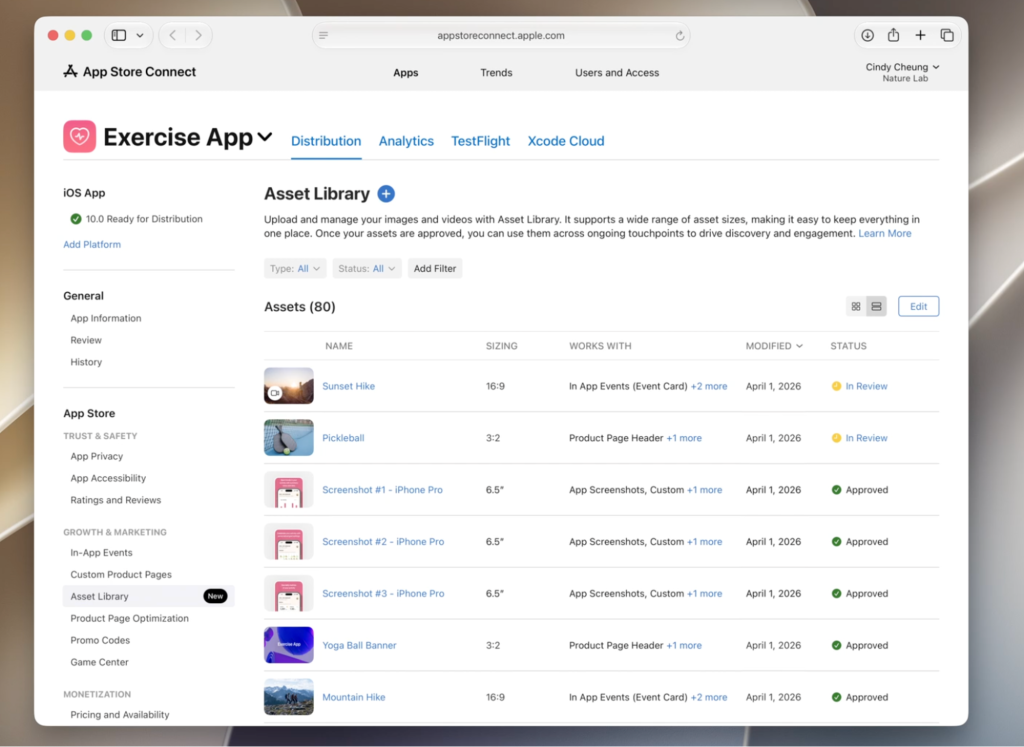
Apple is also introducing an Asset Library in App Store Connect — a centralized hub for managing all creative materials (screenshots, previews, and Creative Assets) in one place. Critically, developers can now upload, submit for App Review, and publish assets independently of an app version update
 Source: Apple
WWDC26: Personalized Collections: App Discovery Becomes Behavioural
What happened: Apple introduced Personalized Collections, a new discovery feature that surfaces app and game recommendations tailored to each user’s individual behaviour, interests, and app usage history. Personalized Collections appear across the Apps, Games, and Search tabs, and alongside each recommendation, App Notes explain why a specific app is being shown to that user.
The feature began rolling out in English in the US on June 8, with additional languages and regions coming soon
WWDC26: Stricter App Review Guidelines: Low-Quality Apps Under Threat
What happened: Apple updated its App Store Review Guidelines (Section 4.3) at WWDC26 with significantly stronger language around low-quality and low-effort apps. The key changes:
- New removal threat for inactive apps: Apps in established, over-saturated categories (dating, flashlight, sound effects, wallpaper, simple timers, fortune telling) that are not updated, not improved, or not attracting users may be removed from the App Store
- No new saturated-category apps: Apple will not accept new submissions in these categories (dating, flashlight, sound effects, wallpaper, simple timers, fortune telling) unless they offer a meaningfully different or improved experience
- Developer Program removal for repeat offenders: Repeated submissions of mediocre, low-quality, or low-effort apps (drinking games, fart apps, simple burp apps) may result in removal from the Apple Developer Program itself
- Live Activities anti-spam rule (4.5.3): Developers are now prohibited from using Live Activities to send spam, phishing attempts, or unsolicited messages
- Strengthened UGC moderation rule (1.2): Developers are responsible for removing content that violates guidelines. Apple will require a compliance improvement plan if violations are found, and can remove apps that fail to respond
Apple Announces iOS Changes in Brazil: Alternative Marketplaces Now Allowed
What happened: On June 18, 2026, Apple announced that iOS in Brazil will now permit alternative app marketplaces and third-party payment systems, following an agreement with Brazil’s competition regulator CADE. The changes, available on iOS 26.5 and later, mirror the framework Apple implemented in the EU and Japan:
- Alternative app marketplaces must be authorised by Apple and pass notarisation
- Developers can include an alternative payment method in-app or link out to a website for payment
- In-App Purchase commission reduced to up to 21% (down from 30%), with some developers qualifying for as low as 10% via Small Business Program, Video Partner Program, or Mini Apps Partner Program
- External website payment links carry a 15% commission (or 10% in some cases)
- Apps distributed outside the App Store pay a 5% Core Technology Commission
Source: Apple
Google Play Console: Marketing Activity Dashboard
What happened: Google updated the main Play Console dashboard in June with a meaningful workflow improvement for ASO practitioners:
Marketing Activity Section: The main Play Console dashboard now includes a dedicated “Marketing Activity” overview showing all active ASO tools and campaigns in one place — including active In-App Events, Store Listing Experiments, Custom Store Listings, and Play Points Promotions. Developers can navigate directly to configuration pages from the dashboard, removing the need to dig through submenus to check campaign status.

Interesting Reads/Listens/Watches
WWDC26 Updates for App Marketers | Phiture
Web-to-App as a Way to Break Out of Silos and Reach New User Groups | Phiture
ASO with Experts:
If you haven’t had access to the product page header until now, Apple may soon make it available to all publishers. While that will make the asset more commonplace (and less distinctive by default) it also creates a valuable opportunity to tell a clearer story about your brand, highlight your app’s key value propositions, and showcase the characters or content your users already love.
Because the header can be either static or video, now is the time to consider how it can support your broader creative strategy and improve conversion. As with every App Store asset, the goal is not simply to attract attention, but to communicate your app’s value quickly, clearly, and in a way that makes users feel both understood and informed.
Talha Mumtaz
Senior Growth Manager
Table of Contents