











Why the Old Growth Playbook Is Dead and What Replaces It
Andy Carvell, CEO, Phiture
Based on a presentation at Business of Apps Berlin 2025
We’re at an Inflection Point
Growth marketing is at a “do or die” moment. Running the tried-and-tested playbook while operating in silos is a decreasingly viable option.
In this article, I make the case for Integrated Growth as the enlightened path forward for growth marketers. Not only is this not terribly new or controversial, but it’s also already understood and being actively practiced by the best marketers and growth teams in the business.
Integrated Growth is not a tactic; it’s a fundamental operating paradigm for growth teams.
This is the Integrated Growth Manifesto.
Who This Manifesto Is For
Readers who can relate to any of the following situations will find this manifesto particularly relevant:
- App marketers who are feeling increasing pressure from a new breed of apps and publishers playing by different rules.
- Growth leaders experiencing diminishing returns from UA, ASO, CRM/lifecycle tactics.
- Teams stuck in silos despite a growing suspicion that there’s a better way to do things.
- CEOs and CMOs under pressure to “do something with AI” while lacking foundational readiness or a clear vision for deploying AI to drive growth.
The Old Playbook Is Dead
Refrains such as “Growth is a holistic system” and “Siloed thinking is a limiter to growth” are as old as the hills. Surely it’s hyperbole to insist that the growth marketing playbook is fast becoming redundant?
I don’t think so. Here’s why.
What’s Changed
- Privacy regulations and signal loss are degrading traditional targeting.
- Automation has flattened execution advantages.
- Creative has become the new targeting.
- Incremental optimization no longer compounds so readily.
- Some challenges in growth marketing have been “solved” by various ad-tech and mar-tech solutions.
- AI, AI, AI…
Moreover, growth teams have genuinely improved. When everyone is operating at a “great” level, “great” becomes table stakes.
We can pat ourselves on the back for the progress that’s been made over the past decade. But the concepts below are tired or expired in high-performance growth teams:
- Siloed functions: ASO, UA, CRM, Product, Monetization, each operating independently.
- Human-paced experimentation.
- A single user journey for all users.
- Reliance on lookalike audiences and third-party signals to inform and scale marketing.
- Doing a lot of “things that don’t scale” to learn.
To some extent, silos are inevitable; they’re a natural consequence of scaling and allow for specialization of skills and processes. New growth channels, tools, tactics, and team hires may deliver uplift, but they can also develop into new silos over time, accumulating experience and data within new confines.
Two Catalysts Accelerating Change
1. Privacy Regulation and Signal Loss
The targeting toolkit is degrading every year. Skip the denial phase and recognize the true value of first-party data:
- The decline of lookalikes and deterministic targeting is almost complete.
- Third-party data is becoming unavailable, unreliable, or, through more robust regulation, untenable.
- As a result, first-party data skyrockets in value and becomes existential.
- Winning teams create growth engines that don’t rely on fragile signals; instead, they collect and intelligently leverage first-party data.
2. AI and Automation
It’s impossible to step outside these days without tripping over a proverbial mountain of “AI” in all flavors, distributed pretty evenly on a spectrum of bullshit-to-brilliant. From hyped-up bollocks touted by the same tryhards who were breathlessly evangelizing Web3 a couple of years ago, all the way to genuine ML, RI, LLM, and hybrid solutions, it’s pretty hard to avoid. And it shouldn’t be avoided, because a decent chunk of what’s packaged as “AI” is genuinely game-changing and currently heavily subsidized to the point of mass availability.
When AI is carefully and craftfully employed, it’s a boon for growth marketers:
- AI fundamentally changes the unit economics of experimentation.
- AI enables scale, speed, and learning loops humans cannot match.
- Teams not leaning into AI will fail to explore the full solution space.
On this last point: AI dispassionately approaches hypothesis generation and experiment design in ways that uncover winning solutions humans would struggle to create.
What Is Integrated Growth?
Integrated Growth is an approach that aligns marketing efforts across the funnel, treating growth as a connected system, prioritized and measured against business outcomes rather than channel-level performance.
Integrated Growth is predicated on these underlying principles:
- Growth is a holistic system, not just a set of channels or siloed activities. Acquisition, engagement, monetization, analytics, data, and tech are interdependent and often bi-directionally synergistic.
- User journeys are nonlinear by nature; Integrated Growth approaches acknowledge and lean into this.
- Insight is generated within (and should be leveraged between) all stages of each user journey.
- First-party data is the connective tissue. It can and should be collected across acquisition, engagement, monetization, and product growth surfaces and leveraged across these surfaces to increase cohesion and personalization (which is a proxy for relevance to the user’s current state).
- AI enriches data and farms insight throughout the system. Smart, self-improving closed-loop agentic automations turbocharge cycle time and enable hyperscale experimentation across a far broader option space than is possible with traditional experimental frameworks.
Integrated Growth = Systems Thinking for Growth

Integrated Growth = Building a cross-funnel ‘growth operating system’, powered by 1st-party data, AI and automation
First-Party Data Is the New Gold
Growth teams are sitting on untapped value. Grab your pickaxe and start hacking.
Rich first-party user data already exists by the bucketload
It’s in device-and-OS-level attributes, in your product analytics, in your creative performance data, explicitly collected survey and onboarding data, and implicitly collected user behavior and content engagement data.
Data is routinely collected but not operationalized
I’ve seen apps that collect terabytes of first-party data per day “just in case” it might be useful. But usually even the average app has rich seams of unmined gold lurking beneath the surface, often trapped within a silo, which are either functional (team or process silos), technological (data silos), or both.
Qualitative signals are underused and underleveraged
Surveys, intent signals, and motivational data remain chronically underleveraged, which is even more of a crime now that AI is pretty great at pairing quantitative with qualitative data when fed both.
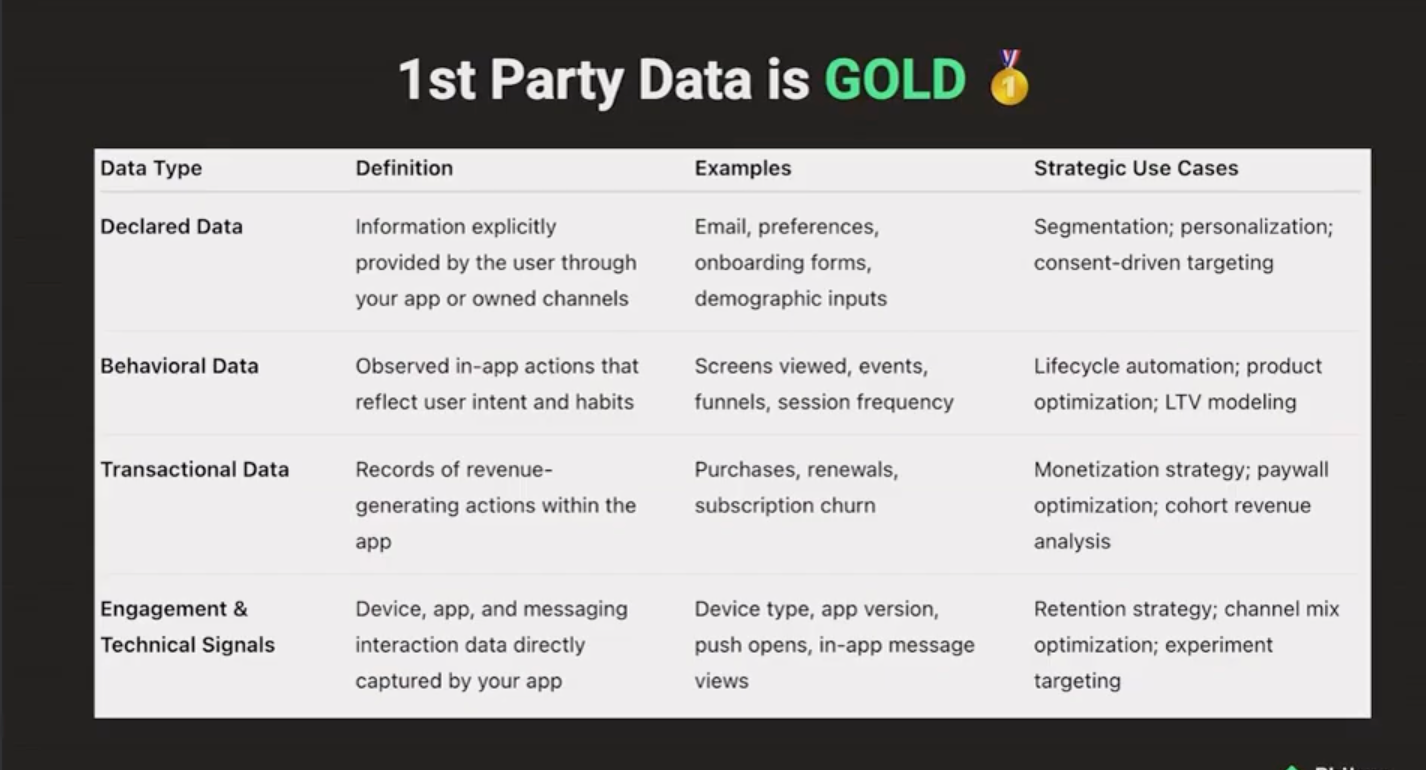
Practical Examples: First-Party Data in Action
In-app surveys enrich profiles, providing segmentation and personalization fuel.
Asking users questions at key points in their journey to obtain insight and enrich profiles might seem obvious, but it’s rare that companies actively and purposefully collect data this way. Over time, you enrich the profile of each active user in your app, whether that’s first-party data that can be leveraged for segmentation and personalization across the entire lifecycle, as well as informing acquisition and monetization tactics.
Using behavioral insight to inform creatives, ASO, UA, and paywalls.
Every app should highlight the most-engaged features and in-app content on their App Store surfaces, UA creatives, and paywalls. Personalization with first-party data might, for example, show a paywall tailored to male vs. female users, or include social proof from users with similar profiles. Gender is just one of many personalization variables and is relatively generic. Getting more personal: any signal or data point that gives a clear indication of user intent can be leveraged to personalize onboarding, paywalls, and other surfaces to increase the perceived relevance and value of the app to each user.
Treat first-party data as a high-value company asset, not as team-specific “working capital.”
Ensure first-party data is available and actionable across your organization. CDPs and data activation platforms can help with the consolidation, transformation, and federation of data from multiple sources. If people outside a specific team (be it ASO, Performance Marketing, CRM, or Product) know how to locate, understand, and action user data without undue friction, that’s a strong indicator that your organization is on pace for the Brave New Digital World.
Crawl, Walk, Run: A Path to Progress
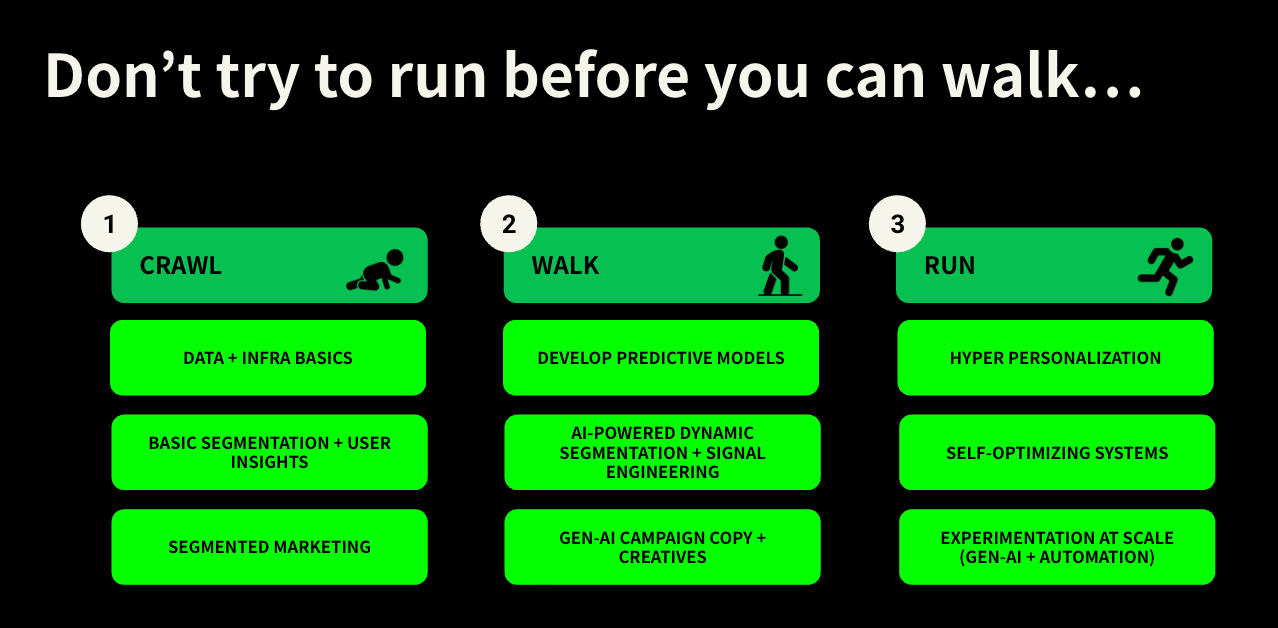
CMOs and CEOs are often excited about the benefits of AI, but may be unaware of the groundwork involved to reap more than surface-level agentic rewards. Such groundwork includes ensuring proper tracking of events and user properties so that there is a decent volume of clean data for the tech to work with.
To reap the full benefits of AI experimentation, teams need data infrastructure and a growth mindset in place. They should already be practicing data-driven experimentation manually, so they know how to train an AI and judge how well it’s performing.
The concept of “garbage in, garbage out” isn’t new, and it isn’t AI-specific, but it’s more relevant than ever. If you’re not collecting and structuring incoming data, good luck generating performance from it with a fancy AI model.
The core martech and data foundations (CDP, CEP, analytics, attribution, and other systems that collect, unify, interpret, and activate customer data) enable accurate tracking of key product, marketing, and revenue metrics. If these foundations are shaky or incomplete, elements built on top (including AI, personalization, and automation) are unlikely to deliver anything close to their full potential.
AI will not fix broken or nonexistent foundations; it will amplify and extrapolate errors while obfuscating their origin.
Cohesion Beats Local-Maxima Optimization
Cohesive user journeys leverage user insights and signals bi-directionally. Pre-install intent signals can personalize the first-time user experience (FTUX), while first-party behavioral data, content consumption, and user-provided survey responses can be mined and forged into valuable signals to inform future acquisition efforts.
Applying Insight Across Growth Surfaces
Use ASO learnings to inform UA creatives and down-funnel personalization
App Store Optimization is often treated as a relatively atomic activity. It’s defensive marketing to maintain discoverability and convert organic traffic into installs.
But ASO isn’t just about increasing visibility and conversion on app store product pages; it’s a growth surface that enables experimentation with creatives, keywords, and more, and it’s for free, given that it uses organic visitors as test cohorts.
ASO is a great way to discover user intent through keyword volumes and conversions. Custom Product Pages (CPPs) and Custom Store Listings can further validate this intent with organic or paid traffic. High-value intent segments can then be specifically addressed in UA through creatives to capture more of these audiences through paid channels.
ASO experiments yield a goldmine of user insight that can either be left to atrophy in an ASO-shaped organizational silo, or fed into an Integrated Growth engine to increase alignment and yield further wins in paid user acquisition and down-funnel to inform product, paywall, and CRM approaches.
Use UA creative performance to inform App Store listings
Conversely, if you’re running ads and find a creative strategy or hook that delivers performance and scale, leverage the concept in your app store assets to increase conversion rate there as well.
If you’re tapping into multiple, diversified audiences with different creative and messaging hooks, develop customized store listings for each of them, with messaging that aligns with the advertising.
Capture in-product behavior and feed it back up-funnel
If you have aggregated insights about what your users prefer, whether product features, benefits that drive the most trials or subscriptions when listed on a paywall, content popularity, or other indications of preference, these can and should be leveraged up-funnel on acquisition and app store growth surfaces.
The theme is alignment and cohesion: squeezing more value from data and user insights by actively using it to create highly relevant, cohesive user flows.
Case Highlights
Audacy: Behavioral Insight Driving ASO Conversion Gains
Audacy, a popular NYC-based radio streaming app, spotted a clear pattern in its US first-party data: usage spiked around commute windows. When they broke it down further, they found state-by-state differences that mapped tightly to drive-time behavior, and they validated the “why” with audience research and in-app surveys.
Phiture turned that insight into a focused creative concept built around the drive-time use case, then pushed it up the funnel so the story was consistent from ad to store. The best-performing variant delivered a 7% uplift in app store conversion.
Compounding a series of small, connected wins across the funnel is usually worth more than chasing a single but siloed “big” win.
Adobe: Intent-Based CPP Optimization Driving +30% CVR
In Japan, we found that PDF editing was the primary reason people used Adobe Acrobat Reader. We built a custom product page that put “Edit PDFs” front and center, which drove a meaningful lift in App Store conversion.
The same message and visual style also outperformed in UA creatives. Adobe then refreshed their App Store graphics using that winning creative approach, and it performed strongly there, too. That closed-loop signal gave confidence to scale the same strategy into performance channels like Meta and Apple Search Ads.
HBO Max: Automated Personalization Replacing Manual CRM Workflows
HBO Max broke down data silos to unlock machine-learning CRM personalization. The CRM team ran regular promotional push campaigns, but content recommendations were only targeted at the country level. Meanwhile, the app itself already incorporated a strong , ML-based, personal recommendation engine, but its outputs were only available in the app and inaccessible within Braze.
Phiture partnered with their engineering team to expose the recommendation engine via an API endpoint. That let Braze pull personalized recommendations automatically into campaigns. The result was a shift from broad, country-level messaging to individual-user targeting, driving a meaningful engagement uplift.
Integrated growth compounds.
AI Changes the Unit Economics of Growth
What AI Enables That Humans Cannot
AI is best used as a force multiplier: it can operate at the speed, scale, and consistency that mobile growth teams simply cannot. It does not replace strategy or judgment; it makes it possible to execute good strategy across thousands of micro-decisions, constantly, across channels and funnel stages.
Hyper-personalization at the individual level.
AI makes 1:1 growth tactics possible: tailoring messaging, offers, and content to each user based on their intent, behavior, and predicted value. In practice, that means dynamically matching UA creative to a relevant store experience, onboarding, and paywall, then adapting CRM messaging as the user evolves. The win is compounding relevance, not one-time lifts.
Pattern discovery across massive datasets.
AI can surface patterns humans miss: subtle combinations of creative elements, audience signals, timing, and app store context that correlate with engagement, conversion, and retention. Instead of debating opinions, teams (or their AI agents) can mine first-party data for repeatable “what works for whom, and when” signals, then turn those into testable hypotheses across markets and channels.
Predictive decision-making.
By modeling billions of historical data points, AI (often via machine learning or reinforcement learning) can predict future outcomes across many scenarios. Pair that with automated decisioning and execution, such as bid adjustments, send-time optimization, and content selection, and you get an always-on, real-time system that adapts faster and cheaper than any human team, with drastically increased speed and scalability.
Creative production with GenAI: deployment and testing at scale.
GenAI changes the economics of creative production. It lets teams generate, deploy, and iterate on large volumes of assets fast enough to match real audience segments, markets, and moments, then learn from performance signals and refine continuously.
Continuous learning via feedback loops.
Integrated feedback loops allow AI to continuously learn and improve, and refine campaigns based on real-time performance. This boosts ROI through dynamic creative testing, real-time bidding adjustments, automated ASO experimentation, dynamic pricing offers, and more. Closed-loop systems are incredibly powerful.
This is a phase change. We’re not necessarily at the universal tipping point yet, but there may come a point soon when teams not employing such systems find themselves at a critical disadvantage with a widening gap to catch up to more progressive competitors. It’s not simply the rate and scale of wins that such systems can produce, but also the continuous, light-speed iteration and compounding aggregation of insight, much of which may also be applicable to new products and surfaces.
What’s Next
This Manifesto is the first piece in a Phiture series on Integrated Growth. Consider it a stake in the ground. In my next articles, I’ll share additional perspectives and examples from the field, and explore what it looks like in practice to build connected loops from UA to store to product to CRM and paywalls.
The goal is simple: make Integrated Growth more concrete and easier for growth teams to apply in the real word. My hope is that this series contributes meaningfully to the current discourse around applied Integrated Growth within the industry and I welcome comments, feedback, challenges and discussion on this topic.
- Read also: The Evolution of Mobile Growth: What’s Changed in 2025 & The Mobile Growth Stack: 2022 Redux
FAQ: Integrated Growth for Mobile Apps
What is Integrated Growth in mobile apps?
Integrated Growth is a cross-funnel mobile app growth strategy that aligns user acquisition (UA), app store optimization (ASO), CRM, product, monetization, and data into one connected system. Instead of optimizing channels in silos, Integrated Growth prioritizes shared insights, first-party data, and business outcomes across the entire user journey.
Why is the traditional mobile app growth playbook no longer enough?
The traditional mobile app growth model relied heavily on deterministic targeting, lookalike audiences, and siloed channel optimization. Privacy regulation, signal loss, and automation have reduced these advantages. Integrated Growth replaces this fragmented approach with a unified, data-driven system powered by first-party data and AI.
How does Integrated Growth improve mobile app performance?
Integrated Growth improves performance by:
-
Connecting insights between UA, ASO, CRM, and product
-
Leveraging first-party data for personalization
-
Using AI to scale experimentation and decision-making
-
Creating cohesive user journeys from ad to store to in-app experience
This alignment compounds small gains across the funnel instead of chasing isolated wins.
What role does first-party data play in Integrated Growth?
First-party data is the foundation of Integrated Growth. It includes behavioral data, survey responses, onboarding insights, creative performance signals, and product usage patterns. When shared across teams, this data enables better targeting, personalization, monetization, and retention strategies in mobile apps.
How does AI support Integrated Growth?
AI supports Integrated Growth by:
-
Enabling large-scale experimentation
-
Discovering patterns across complex datasets
-
Automating personalization across acquisition and engagement
-
Powering predictive decision-making
AI does not replace strategy; it amplifies strong data infrastructure and cross-functional alignment.
Is Integrated Growth only for large mobile app companies?
No. While enterprise apps may have more resources, the principles of Integrated Growth apply to any mobile app team. Even small teams can break down silos, operationalize first-party data, and create feedback loops between UA, ASO, CRM, and product.
How can a mobile app team start implementing Integrated Growth?
Mobile app teams can begin by:
-
Auditing data infrastructure and tracking accuracy
-
Identifying siloed insights that could benefit other teams
-
Aligning growth metrics around business outcomes, not channel KPIs
-
Creating feedback loops between acquisition, store, product, and CRM
-
Layering AI and automation only after data foundations are solid
Table of Contents