









The tech industry took a significant leap forward in making AI platforms available for developer access when OpenAI launched its GPT Store concept in January 2024. While this initial version focused on allowing anyone to create and share custom GPTs (specialized AI assistants customized for specific tasks), the real leap came in December 2025, when OpenAI introduced its App Directory. Unlike the earlier GPT Store, which focused on simple prompt-based customizations, the new App Directory enables full third-party application integrations powered by the Apps SDK (Software Development Kit).
In this article, we discuss the advent of the OpenAI App Directory, what apps are already leveraging it, why more apps should leverage it, and whether it is a good idea for your app to integrate with the App Directory.
The Quick Read
- ChatGPT now has 800 million weekly active users, surpassing even the Apple App Store’s 650 million. For app publishers, this platform is too large to ignore.
- The App Directory launched in December 2025 and represents a major upgrade from the earlier GPT Store, enabling full third-party integrations through the Apps SDK rather than simple prompt-based customizations.
- Early movers include Spotify, Adobe Acrobat, Canva, Booking.com, MyFitnessPal, and AllTrails, each offering conversational access to core product features directly inside ChatGPT.
- OpenAI’s revenue trajectory signals a highly engaged, paying user base. Annual recurring revenue hit $13 billion by August 2025, and the mobile app alone generated $2.48 billion, a 408% year-over-year increase.
- Discovery in the App Directory is still basic. The name carries the most indexation weight, long-tail keyword searches don’t yet work reliably, and keyword stuffing risks rejection.
- Stripe-powered Instant Checkout enables in-chat commerce purchases for US users, though digital services cannot yet be sold through the integration.
- Submitting an app requires an icon, name, descriptions, screenshots, a verified website, and an MCP server, along with mandatory testing before review.
- For apps whose core functionality can be delivered conversationally, integrating with the ChatGPT App Directory offers a new path to discovery, qualified leads, and brand awareness.
What Is a ChatGPT App?
First things first: What exactly is a ChatGPT App? According to OpenAI, “A ChatGPT app is a set of well-defined tools that can perform tasks, trigger interactions, or access data.”
A ChatGPT app is not a normal app you download and open on your phone. Instead, it is a capability that works inside ChatGPT and shows up only when it is useful in a conversation. Rather than having its own screens, buttons, and navigation like an iOS or Android app, a ChatGPT app focuses on doing one or two specific things well (such as pulling data, taking an action, or returning structured results) and lets the AI decide when to use it.
Traditional mobile apps rely on users learning how to navigate them, while ChatGPT apps rely on natural language: you just ask, and the AI connects the right tools at the right moment. The result is software that feels less like an app you open and more like a helpful ability that appears exactly when you need it.
Background: The Numbers Say It All
As per multiple sources, OpenAI’s ChatGPT leads in weekly active users by a significant margin. Currently at 800 million weekly active users, the number is even greater than the 650 million weekly active users visiting the Apple App Store. This means that mobile apps cannot ignore the vast appeal of this platform, as ChatGPT has quickly become the go-to tool for multiple use cases being discovered and managed by users around the world. Publishers that integrate their apps with ChatGPT may stand a higher chance of discovery and brand recognition than those who rely solely on the native app stores.
Apart from the active users, the number of paying users is also impressive. OpenAI’s annual recurring revenue hit $13 billion by August 2025, with projections suggesting it could exceed $20 billion by year-end. The mobile app specifically generated $2.48 billion in 2025, representing a staggering 408% year-over-year increase from the $487 million earned in 2024. This means that by integrating your app within ChatGPT, you are also exposing it to pre-qualified users who may be willing to pay for your app individually if it fits their needs.
What Brands Are Currently Leveraging the ChatGPT App Integration?
While more and more apps are now being integrated within the OpenAI App Directory, here are some early movers and notable names that have integrated their apps within ChatGPT to offer users an innovative brand interaction.
Spotify
Spotify’s integration enables users to create playlists, discover music, and manage their libraries through natural language conversations. Instead of manually searching and curating playlists, users simply describe what they want (“create a running playlist with high-energy 2000s rock”) and ChatGPT handles the execution.
Adobe Acrobat
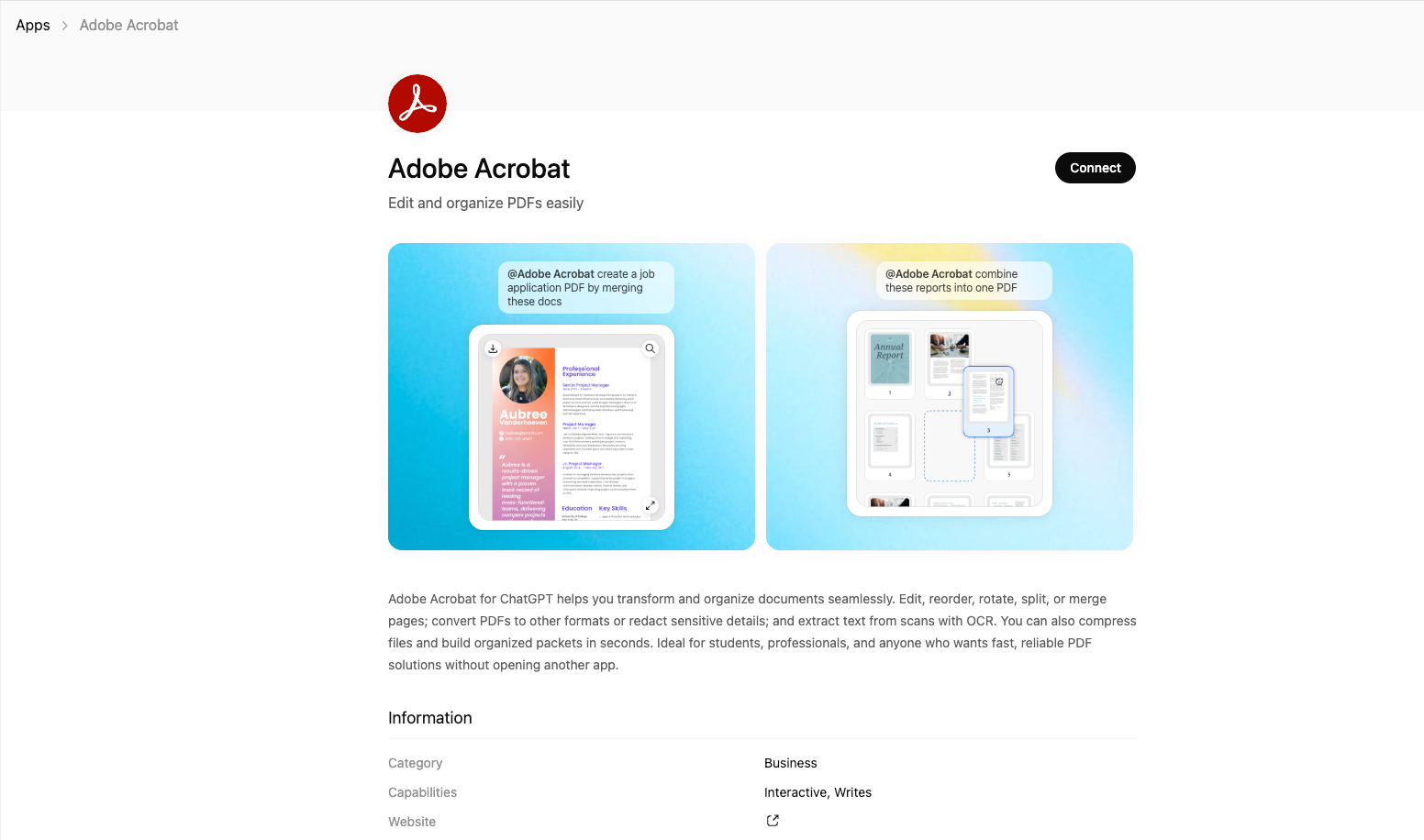
Adobe Acrobat’s integration allows users to edit documents easily. Users can edit, rotate, split pages, convert, and compress documents without ever leaving the ChatGPT interface.
Canva
Canva’s integration showcases the power of conversational productivity tools. Users can edit entire presentations, create new graphic designs, and modify files through simple chat commands.
Booking.com
Booking.com has integrated with ChatGPT to enable end-to-end travel planning within conversations. Users can specify travel dates, budgets, number of travelers, star rating preferences, and neighborhood requirements, with ChatGPT presenting filterable options in real time.
MyFitnessPal
MyFitnessPal also offers a ChatGPT integration that helps users generate meal plans, recipes, and personalized nutrition guidance interactively.
AllTrails
AllTrails partnered with OpenAI as a launch partner for ChatGPT apps, enabling users to discover hiking trails and outdoor activities conversationally.
How to Use Apps Within ChatGPT
OpenAI has made these app integrations very easy to access and connect within your regular workflows. Here is a quick look at how to connect with these apps:
1. Simply go to the Apps tab in the side column from the chat interface:
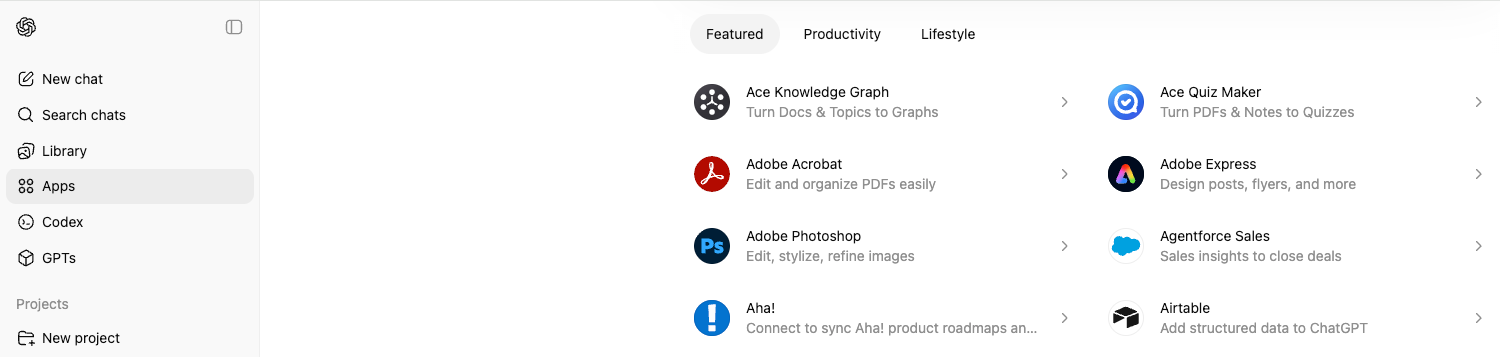
2. Select the app you want to connect to and tap on connect:
3. Select to continue with or without your account:
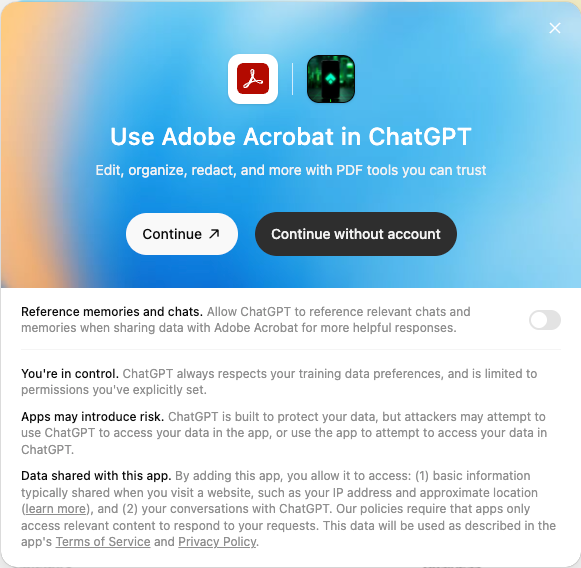
4. Set preferences as per your usage:
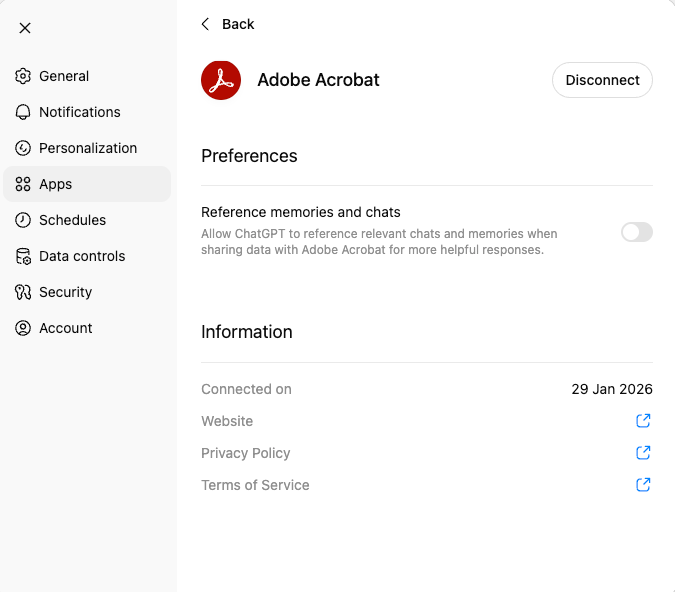
5. You can select between the apps by tapping on more when starting a chat:
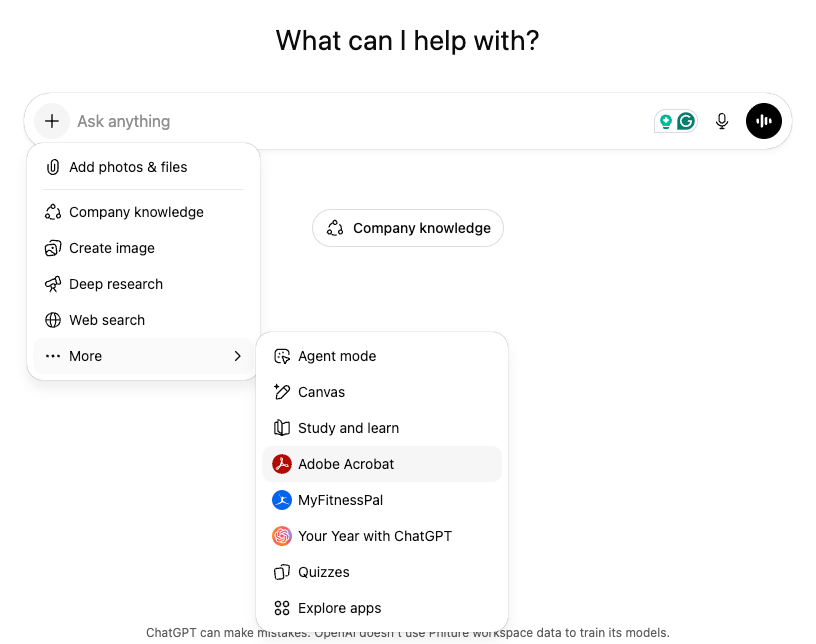
As you can see, it is really easy to integrate these apps within your daily workflow and get relevant answers.
How Does the Discovery System Work in the OpenAI App Store?
Similar to other app stores, the OpenAI App Store allows you to upload an icon, screenshots, a name, and short and long descriptions. You will also need to select a category name, add a developer name, and include a privacy policy and terms and conditions.
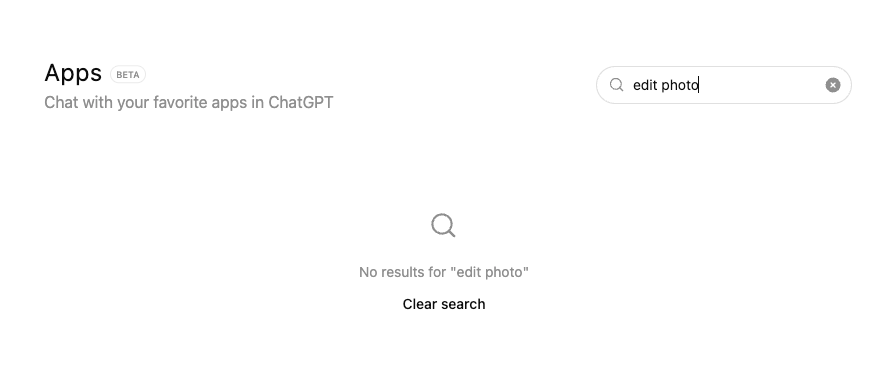
Long Tail keyword Results
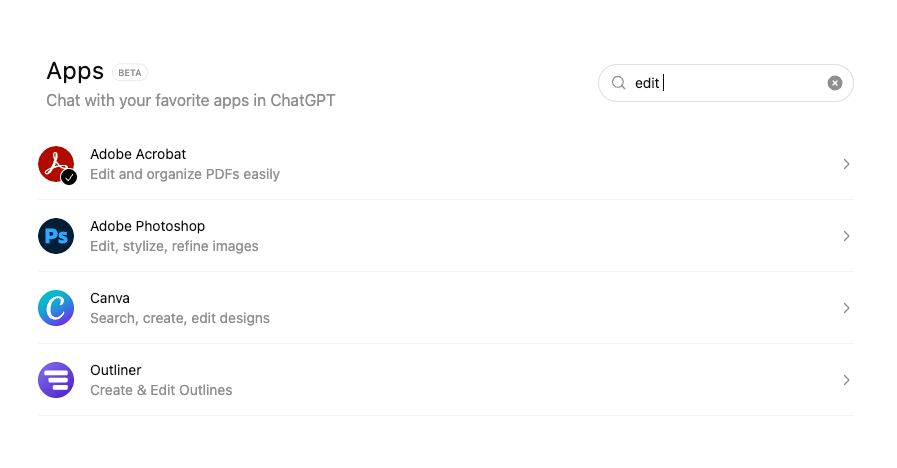
Individual Keyword Results
As per OpenAI’s official documentation, users can connect their app either by installing it directly or by searching for it by name, so it becomes crucial to adopt a name users are most familiar with. Apps should select a name that combines their branding with the best use cases to ensure relevance for users discovering new apps to connect.
OpenAI also suggests that it may decide to improve discoverability based on the quality of the product.
Also note that, similar to the Google Play Store, stuffing your description with unnecessary terms, use cases, or prompting triggers in order to manipulate the ChatGPT algorithm may result in a rejection.
From our research, we found that, unlike other established app stores, the ChatGPT App Directory is still in its infancy and fairly conventional when it comes to indexation. While the name and short description are indexed, the name holds the most weight. The search system is also not sophisticated enough right now to surface results based on long-tail keywords, so it is better to use keywords that stand on their own individually (for example, “edit” and “designs” show results individually, but “edit designs” does not).
How to Submit an App to the OpenAI ChatGPT App Directory
OpenAI has released submission guidelines as well as optimization best practices for publishers to review before submitting their apps to the App Directory. Here is a quick look at what is required:
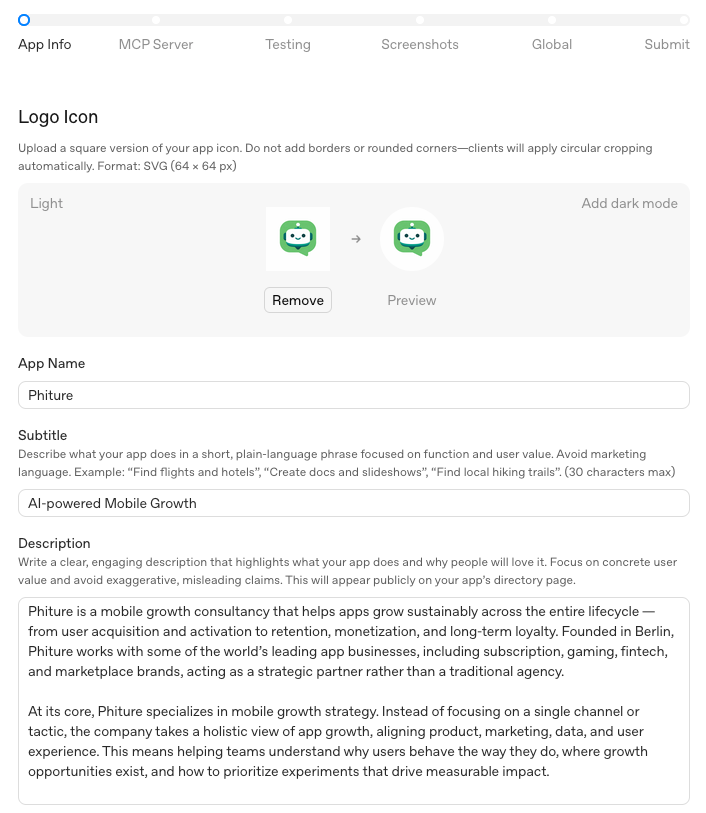
- An icon (64 × 64 px), which must be under 5 KB
- A name (30 characters)
- A short description (30 characters)
- A long description (4,000 characters)
- Developer name, privacy policy, and terms & conditions
- Screenshots
- A website, which needs to be verified first
- An MCP server
Testing is also required before you can submit your app to the App Directory for review. Note that you will need to declare if you intend to take users out of the ChatGPT interface to make purchases. OpenAI only supports commerce purchases within the interface.
OpenAI also asks you to think through all the prompting use cases your users might try when interacting with your app. By coming up with potential use cases, you may be able to achieve a higher retention rate with users engaging with your product.
Benefits of Integrating Your App Within ChatGPT
Qualified Leads
With most ad platforms and app stores adopting a cookieless, attribution-safe approach, it is becoming increasingly difficult for apps to screen and distinguish high-quality and suitable leads. By offering the app within ChatGPT, the high-quality users who already pay for ChatGPT may be willing to pay for your app individually, qualifying them as potential leads.
Convert Directly
OpenAI partnered with Stripe to introduce Instant Checkout, which allows users in the US to buy products instantly without ever leaving the chat interface. Stripe facilitates the transaction in the background, supporting credit cards, Apple Pay, Google Pay, and Link. While it remains to be seen if complete app offerings can be purchased using Instant Checkout, this gives us a hint at a potential monetization plan for partner apps.
Brand Awareness
With 800 million weekly active users, having your app where most users can access it easily can result in significant brand awareness.
An important caveat: for now, OpenAI does not allow publishers to sell digital services. You can only sell commerce products within the ChatGPT app integration as mentioned here.
How Phiture Can Help
The ChatGPT App Directory represents a new frontier for app discovery and user acquisition, but navigating it effectively requires the same strategic thinking that drives success in traditional app stores. Understanding how to position your app, optimize your listing, and connect with qualified users within this ecosystem is where growth expertise makes the difference.
At Phiture, we’ve developed frameworks like the Mobile Growth Stack and ASO Stack that help teams build systematic approaches to sustainable growth across every relevant platform. Our ASO and App Store Strategy services can help you evaluate whether the ChatGPT App Directory is the right fit for your product and how to maximize visibility within it, while our Paid Media practice can help you understand how this new channel fits into your broader acquisition strategy.
For teams exploring whether the ChatGPT App Directory should be part of their growth roadmap, a free consultation can help identify the opportunity and outline next steps.
For more frameworks on sustainable mobile growth, explore the Mobile Growth Stack and ASO Stackresources.
Frequently Asked Questions
What is a ChatGPT app?
A ChatGPT app is a third-party integration that works inside the ChatGPT interface. Rather than functioning as a standalone application, it provides specific capabilities (such as pulling data, completing tasks, or returning structured results) that the AI activates when relevant during a conversation.
How is the ChatGPT App Directory different from the earlier GPT Store?
The GPT Store, launched in January 2024, focused on simple prompt-based customizations. The App Directory, introduced in December 2025, enables full third-party application integrations powered by the Apps SDK, allowing for much deeper functionality and real task execution.
How many people use ChatGPT?
ChatGPT currently has 800 million weekly active users, which exceeds the 650 million weekly active users visiting the Apple App Store.
Can I sell products or services through my ChatGPT app integration?
OpenAI has partnered with Stripe to enable Instant Checkout for commerce products within the US. However, OpenAI does not currently allow publishers to sell digital services through the ChatGPT app integration.
What do I need to submit an app to the OpenAI App Directory?
You will need an icon (64 × 64 px, under 5 KB), a name (30 characters), short and long descriptions, a developer name, privacy policy, terms and conditions, screenshots, a verified website, and an MCP server. Testing is also required before submission.
How does search and discovery work in the ChatGPT App Directory?
The App Directory allows users to find apps by name or through search. Currently, the name carries the most weight in indexation, and the search system does not yet support long-tail keyword queries effectively. It is better to use keywords that work individually rather than as combined phrases.
Is the ChatGPT App Directory worth it for my app?
With 800 million weekly active users and a rapidly growing paying user base, the ChatGPT App Directory offers a significant opportunity for discovery and brand recognition. It is particularly valuable for apps whose core functionality can be delivered conversationally, such as productivity tools, travel planning, content creation, and health and fitness apps.
Table of Contents